
Can You Get a Mining Job in Australia with No Experience?
The honest answer for UK and Irish readers thinking about FIFO: from two people who've actually lived it.
By Vicki & Amy | The Free Range Humans | 8 min read
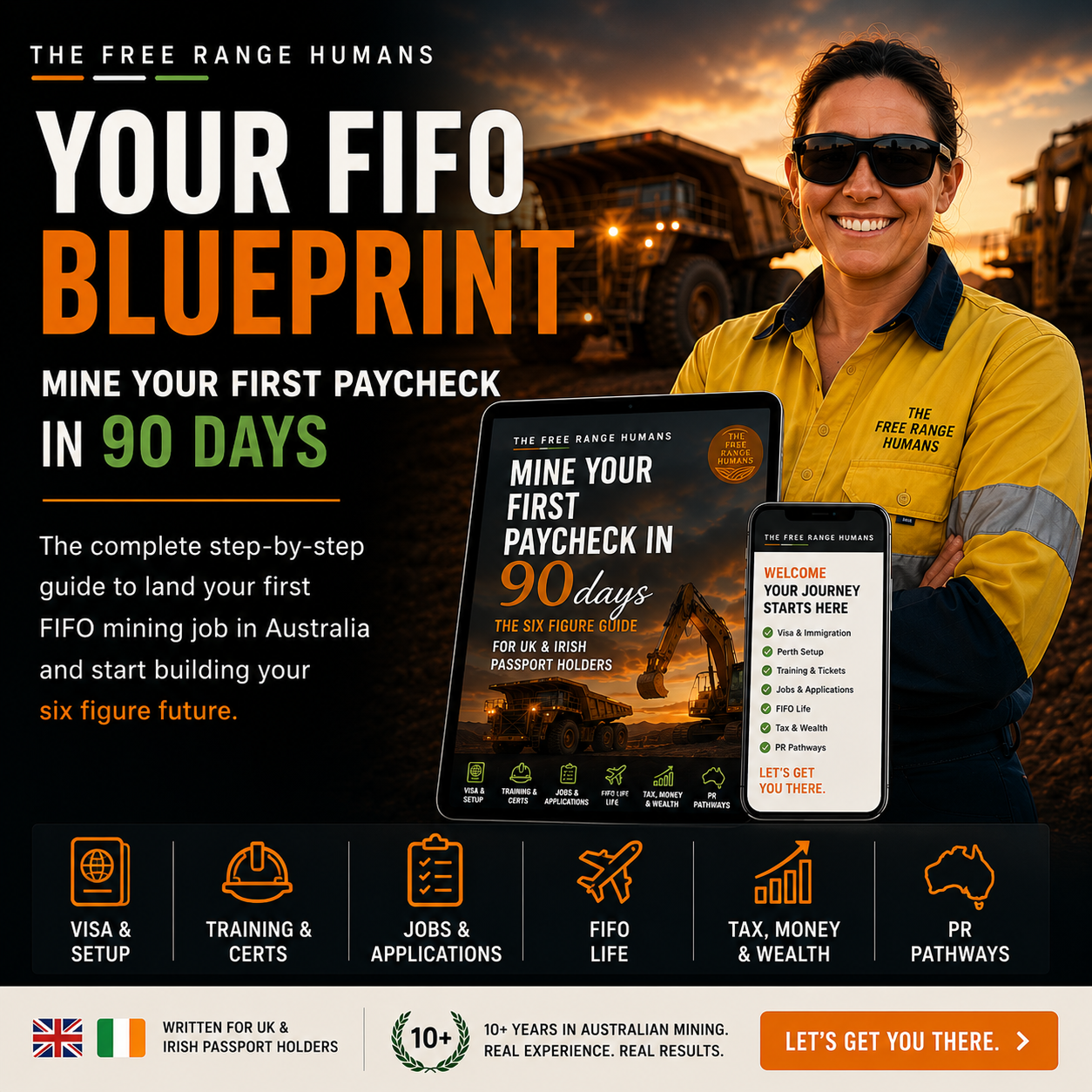
Zero experience. UK or Irish passport. 90 days. Here's exactly how.
The Free Range Humans
You've seen the videos. The TikToks. The "I moved to Australia with £800 and now I make six figures" posts you've scrolled past three times this week telling yourself it's not real.
Maybe you've even typed the question into Google at 11pm on a Sunday night, "can you get a mining job in Australia with no experience", then closed the tab because you didn't quite trust what came up. Because those sites sound like they're selling something. Because it feels too good. Because someone like you, from where you're from, with your background, probably isn't who they mean when they say, "entry level."
We get it. Vicki felt exactly the same way living in the UK before she booked a one-way flight to Perth.
She had no mining experience. No trade. No contacts in Australia. Just a Working Holiday Visa, a willingness to do hard things, and the slightly terrifying feeling that maybe this could actually work.
It did. Vicki spent years across sites including Greenbushes, South Flank, the Goldfields, and the Pilbara, picking up a wide range of roles across construction mining, underground, the port and everything in between. Amy came at it from a completely different direction, occupational physiotherapist at BHP Nickel West, then project management and business improvement at BHP Iron Ore. We met on site in Leinster. Vicki was Amy's patient.
Between us we've watched hundreds of people walk onto their first site wide-eyed and skint and leave years later with their lives completely changed.
So, we're going to answer the question properly. Not the glossy version. The real one.
Article at a Glance
- UK and Irish passport holders can get FIFO mining jobs in Australia with zero prior mining experience; the pathway is real and well-established.
- Entry-level roles pay $75k–$140k AUD (~£38k–£70k), with flights, food, and accommodation fully covered on site.
- The Working Holiday Visa (subclass 417) is the fastest legal route in for 35s and under, and mining work is fully permitted on it.
- Labour hire agencies, not direct applications to BHP or Rio Tinto, are where entry-level volume actually sits. There's a specific sequence of steps that gets people from zero to their first paycheck in under 90 days. Most people skip half of them.
In This Post
- What is FIFO, actually?
- Why mining companies hire people with no experience.
- The entry-level roles open to beginners, with salary table.
- What you actually need before you apply
- What 'no experience' really means to employers
- Your CV, don't skip this.
- What about the money?
- The trap nobody warns you about.
- So why doesn't everyone do it?
- The short answer
- Frequently Asked Questions
1. What is FIFO, actually?
FIFO stands for Fly-In, Fly-Out. It means you fly to a remote mine site for a set roster period, commonly two weeks on, one week off (2:1) or eight days on, six days off (8:6), and the company covers your flights, accommodation, and meals while you're on site. You work 12-hour days or nights and save essentially everything you earn.
Most of Australia's mining action is in Western Australia, the Pilbara in the north, the Goldfields in the east, the Murchison, the Kimberley, and the Southwest. Western Australia is enormous. You can drive twenty-plus hours and still be in the same state. Hence the planes.
It's not glamorous. The remote sites can be isolating. The rosters mess with your sleep. But the money is real, the variety of work is genuine, and for people who want to save hard and live differently, it changes lives.
LEARN MORE HERE>>
Common FIFO Roster Types
• 2:1: two weeks on site, one week off. Most common in WA. Higher base rates.
• 8:6: eight days on, six days off. Better work-life balance, popular closer to Perth.
• 7:7: seven on, seven off. Growing in popularity, particularly in lithium operations.
• 4:1: four weeks on, one week off. Less common, higher earning potential, harder lifestyle
2. Why Mining Companies Hire People with No Experience
Mine sites run 24/7 and need a constant pipeline of workers at every level. High turnover, expansion projects, and the sheer scale of operations means there are always gaps to fill.
Large open-cut and bulk commodity operations need significant numbers of workers in physical, support-based, and entry-level roles that don't require prior industry knowledge. These roles come with structured on-site inductions and training programs specifically designed to bring people up to speed fast. The industry builds the experience it needs rather than waiting for it to walk through the door.
That's genuinely good news for anyone reading this.
LEARN MORE HERE>>
3. The Entry-Level Roles Open to Beginners
Here's what the mining industry doesn't advertise loudly: large mine sites run like small towns. They need cleaners, kitchen hands, labourers, and support staff just as much as they need drill operators.
Amy actually did exactly this. At 20, back in 2007, she spent two years working on a mining site in the Southwest of WA as a kitchen hand and bar staff. She made some of her best friends there and saved enough to travel Europe afterwards. It was never the plan; it just turned out to be a really good one.
Don't underestimate support services!
You're living alongside miners, operators, and supervisors every single day, on the same planes, eating in the same mess, living in the same camp. People get noticed. It's extremely common for someone who started in the kitchen or on the cleaning crew to be across in an operator or TA role within their first year. Sometimes the best way in is just getting on site.
LEARN MORE HERE>>
| Role | Salary (AUD) | Approx. GBP | Experience Required |
|---|---|---|---|
| General Labourer | $95k - $120k | ~£47k – £60k | None |
| Haul Truck Operator | $100k - $120k | ~£50k – £60k | None (trained on the job) |
| Trade Assistant | $95k - $120k | ~£47k – £60k | None |
| Diamond Driller's Offsider | $100k - $140k | ~£50k – £70k | None (trained on the job) |
| Underground Truck Operator | $100k - $140k | ~£50k – £70k | None (trained on job) |
| Nipper | $110k - $120k | ~£55k – £60k | None |
| Camp / Utility / Kitchen Hand | $75k - $100k | ~£38k – £50k | None, most accessible entry point |
| Chef / Cook | $90k - $120k | ~£45k – £60k | Hospitality background |
4. What You Actually Need Before You Apply
You don't need experience, but you do need to arrive prepared. Think of this as your pre-flight checklist. Each item is straightforward on its own. The people who struggle are usually the ones who arrive without a plan and spend their first month figuring out what they should have sorted before they left home.
The right visa
For UK and Irish passport holders 35 and under, the Working Holiday Visa (subclass 417) is your entry point. It costs around £335, grants full working rights from day one, and mining is fully permitted. No job offer required. No sponsor. Apply online, get approved, book your flight.
Age matters, if your 36th birthday is six months away, that clock is ticking. Move now.
Your White Card, the only mandatory ticket
The White Card is your mandatory safety certification for every Australian mine and construction site. Non-negotiable. No card, no site access, full stop.
Critical detail for UK and Irish applicants: the White Card can only be completed on Australian soil. Do it in Perth, in your first week, in a classroom, not online. Here's the process:
• Book a face-to-face course through a registered training organisation (RTO), providers like Allens Training and AHSA run same-day sessions in Perth.
• The course takes approximately six to eight hours.
• Cost is typically $60–$120 AUD.
• Your card is issued the same day or within a few days.
• Nationally recognised across all Australian states and territories
• It does not expire, once you have it, you have it for life.
Get this done in week one. Showing up to an agency registration with your White Card already done tells them you're serious. Showing up without it tells them you're not.
Valid Driver’s Licence
A current driver's licence from your home country is required. One of your first tasks when you arrive in Perth is converting it to a WA licence, do this in your first week alongside your White Card.
A Perth base
Almost all FIFO operations in WA fly out of Perth Airport. Employers require a Perth address before considering your application, it tells them you're available for rapid deployment. Registering with agencies from overseas or another Australian city puts you at the back of the queue almost every time. Start in a hostel, get your bearings, move into a share house once you know where you want to be.
A mining-specific, ATS-optimised CV
Your standard CV from back home will not work. Applicant Tracking Systems filter applications before a human ever sees them, and a CV that isn't built around mining-relevant keywords gets rejected automatically.
More on this in Section 6.
A financial buffer
The Australian government requires around £2,500 GBP (~$5,000 AUD) in your account when applying for the WHV. In practice, you need more, the first few weeks in Perth involve setup costs before your first paycheck arrives.
LEARN MORE HERE>>
| Cost | Approx. Amount |
|---|---|
| Working Holiday Visa fee | ~£335 (~$670 AUD) |
| Flights to Perth | ~£700–£1,100 (~$1,400–$2,200 AUD) |
| First 2 weeks accommodation | ~£250–£450 (~$500–$900 AUD) |
| White Card course | ~£30–£60 (~$60–$120 AUD) |
| Pre-employment medical | ~£75–£125 (~$150–$250 AUD) |
| Food, transport, SIM (first month) | ~£300–£450 (~$600–$900 AUD) |
| Setup buffer | ~£250–£500 (~$500–$1,000 AUD)~£2,000–£3,000 (~$4,000–$6,000 AUD) |
| TOTAL (excl. flights) |
Once you're on site, your costs drop to near zero. Every dollar you earn on your first roster is essentially clear savings.
The initial outlay recovers fast.
Physical readiness
You'll pass a pre-employment medical, musculoskeletal assessment, drug and alcohol screening, and sometimes a fitness test depending on the role. For most utility and support roles the bar isn't extreme. For driller's offsider and plant operation roles, fitness matters.
National Police Check
Every mining employer requires one before onboarding. Apply online, save the PDF, you'll need it multiple times.
LEARN MORE HERE>>
5. What 'No Experience' Really Means to Employers
When a job ad says, "no experience necessary," it almost always still means no mining experience. Employers still expect some baseline, a White Card, a valid driver's licence, and ideally some background in a physically demanding or trade-adjacent environment.
Previous work in construction, agriculture, warehousing, transport, hospitality, or even growing up on a farm translates surprisingly well. The bar isn't zero, but it's lower than most people assume, and entirely achievable with a few weeks of focused preparation.
Work backgrounds that transfer well
• Trades and construction, obvious fit, strong signals
• Agriculture and farming, physical capability, machinery, early starts.
• Warehousing and logistics, procedural work, reliability, forklift often a bonus
• Military service, safety-critical environment, following instructions under pressure.
• Hospitality, shift work, customer-facing, high pressure, transfers better than most people expect.
• Manufacturing, repetitive precision work, safety protocols
The framing of your experience is as important as the experience itself. A CV written for a mining application looks completely different from a general CV, and that gap is where a lot of applicants lose opportunities, they were otherwise qualified for.
One important thing: don't apply direct to the big miners first.
BHP, Rio Tinto, and Fortescue's pipelines favour people with site tickets and verified FIFO history. Labour hire agencies are where the real entry-level volume sits. Register with multiple agencies simultaneously, Skillforce, Techforce, WorkPac, Programmed are good starting points. Be upfront about your experience level. They're incentivised to place you.
Common myths that stop people from ever applying
- "You need a trade to work on a mine site.,” False. Trades make up a portion of the site workforce, not the majority.
- "You need an HR licence before you apply,” False. Not required for most entry-level roles. Don't spend $1,500 AUD and several weeks getting one before you have a job offer.
- "Big mining companies hire directly for entry-level roles,” Rarely. Labour hire agencies are the pipeline.
- "You have to be Australian.,” False. Working Holiday Visa grants full working rights. FIFO sites employ UK and Irish workers regularly.
- "It takes months to get your first role,” Only if you don't follow the right process.
LEARN MORE HERE>>
6. Your CV, Don't Skip This
Your CV is doing the first interview before you've spoken to anyone. Most large recruitment agencies and mining companies use Applicant Tracking Systems (ATS), software that scans your CV for keywords, formatting, and structure before a human ever looks at it. A CV that looks great but isn't ATS-optimised gets rejected automatically. It happens constantly, and most people never know why they're not hearing back.
Three things that matter more than most people realise.
- Keywords, if the role says, 'trades assistant' and your CV says, 'site helper,' the ATS may not connect the two.
- Format, tables, text boxes, and graphics cause ATS systems to misread or skip sections. Simple and clean wins every time.
- Relevance, a CV written for the Australian mining market reads differently to a UK or Irish one. A recruiter can tell immediately when it hasn't been adapted.
We offer three CV packages depending on where you're starting from:
CV ATS Checker, £19. Upload your CV and a job ad, run it through our ATS checker to see exactly where you're losing out before you apply
CV Template, £19. ATS-optimised CV and cover letter template built for the Australian mining market. You fill it in.
CV Reformat, £99. Send us your existing CV and we'll reformat it, clean up the language, and ATS-optimise it for the mining market.
CV Done for You, £169. No CV? No problem. Answer a few questions and we'll build your mining CV and cover letter from scratch. Ready to send.
Not sure which is right for you? See what we've got for you here!
7. What About the Money, Is It Really as Good as People Say?
Yes. But the salary is only half the story.
Entry-level utility and camp services roles pay $75k–$100k AUD (~£38k–£50k). Trade assistants can expect $95k–$120k AUD (~£47k–£60k). Driller's offsiders often clear $100k–$140k AUD (~£50k–£70k). And because your accommodation, meals, and flights are covered on site, your ability to save is genuinely unusual compared to most jobs.
Compare that to life back home, rent, food, bills, transport, council tax. A single person in the UK is typically spending £1,500–£2,500 a month just to keep the lights on. On a 2:1 FIFO roster, two thirds of your working life have none of that.
We're not just talking about people we know, we are those people. The mining income we saved is a big part of why we're now travelling the world full time with our daughter. That's the real endgame. And it starts with getting on site.
The full picture on tax, super, and how to make the money work is in the guide. LEARN MORE HERE>>
8. The Trap Nobody Warns You About
The money is real. But so is the lifestyle creep, and the mining industry has swallowed more people financially than most would admit.
It goes one of two ways. The first is debt. Someone gets their first big paycheck, feels flush for the first time in their life, and starts spending like it's permanent. A new ute on finance. A boat. A credit card that suddenly feels manageable. Before long they're rostered on not because they want to be, but because they have to be. The golden handcuffs snap shut fast.
The second is the blow-out. Seven days off, seven days of hard living, eating out every night, weekend trips that cost more than the flights to site. Fun? Absolutely. A financial strategy? Not even close.
Before you get on site, get clear on what you're building toward.
The mining income is a window, a short, focused season to build something that works for you long after you leave site. We used ours to buy our freedom. That's what we want for you too. But it only works if you go in with a plan.
LEARN MORE HERE>>
9. So Why Doesn't Everyone Do It?
Because it's not easy, and it's not for everyone.
Twelve-hour shifts in extreme heat. Weeks away from people you love. Sites that are genuinely remote. A camp lifestyle that can feel repetitive. The mental health challenges of FIFO work are real and documented, isolation, disrupted sleep, and relationship strain all feature. Anyone who tells you otherwise hasn't actually done it.
We're not here to sell you a fantasy. We're here because we did it, we understand it, and we want to give you the full picture so you can make a real decision, not one based on a 30-second TikTok.
LEARN MORE HERE>>
10. The Short Answer
Yes, you can get a FIFO mining job in Australia with no experience. The pathway is clear, the entry-level roles exist, and the money is genuinely life-changing if you approach it strategically.
You need the right visa, a White Card, a Perth base, a realistic financial buffer, and a CV that doesn't immediately say "I've never been near a mine site." Everything else you can learn on the job.
UK. Plane. Perth. Train. Hired. That's the path. And we know every single step between here and there.
The Complete FIFO Guide for UK & Irish Passport Holders
Most people spend months fumbling around online trying to piece this together. We've done it, we've lived it, and we've put everything you actually need into one place. The visa, the Perth admin checklist, the ATS-optimised CV template, the recruitment agency list, the salary breakdown, the tax timing strategy, all of it.
Zero experience. UK or Irish passport. 90 days to your first paycheck.
The complete step-by-step pathway, visa, Perth setup, CV, training, agencies, first paycheck, is all in the guide.
Ready to get on site? Here's everything we offer.
The Six-Figure FIFO Guide – £44 The complete step-by-step playbook. Visa, Perth setup, CV, agencies, first paycheck. Nothing missing.
ATS CV Checker – £29 Already got a CV? Run it against a real job ad and find out exactly where you're losing out before you apply.
ATS-Optimised CV Template – £19 Built for the Australian mining market. Formatted to get through ATS filters and land on a recruiter's desk.
CV Reformat Service – £99 Send us your existing CV. We'll reformat it to Australian mining standards — ATS-ready, right keywords, right structure.
CV Done For You – £169 We build your mining CV from scratch. You answer a few questions, we do the rest. Ready to send to recruiters.
1:1 Strategy Call with Vicki – £149 60 minutes with someone who's done it. Your questions answered, your plan mapped out, your next steps clear.
3x Strategy Calls – £399 Ongoing support as you work through the process. Three sessions spread across your journey.
Bundles – from £52 Guide + CV template. Guide + reformat. Guide + calls. Starter, Accelerator, and VIP packages available.
Frequently Asked Questions
Can I get a FIFO job on a Working Holiday Visa?
Yes. The Working Holiday Visa (subclass 417) grants full working rights in Australia; mining is fully permitted. It's available to UK and Irish citizens aged 18–35 (inclusive), costs around £335, and is applied for online. You do not need a job offer before applying. You apply, arrive, set up in Perth, and start the agency process from there.
How much money do I need before I go?
The Australian government requires around £2,500 GBP (~$5,000 AUD) in your account when you apply for the WHV. In practice, arriving with only the minimum is a risk. Budget approximately $4,000–$6,000 AUD on top of flights to cover your first 4–6 weeks before your first paycheck lands. See the budget table in Section 4 for the full breakdown.
Do I need any formal qualifications?
No. The only mandatory certification is a White Card, a half-day safety course completed in Perth after you arrive. No degree, no trade, no prior mining certification required. Over time, additional tickets (forklift, EWP, HR licence) expand your options, but they are not prerequisites for getting started.
Do I need an HR licence to work in mining?
No, and this is one of the most common misconceptions. An HR licence is not required for most entry-level roles. Mine site vehicles operate under different rules to public roads. Don't spend money on an HR licence before you have a job offer.
Do I need to live in Perth to get a FIFO job?
For the vast majority of WA FIFO roles, yes. Most sites fly out of Perth Airport and employers require a Perth address before considering your application. Budget for at least two to four weeks of accommodation while you get set up.
How long does it take to get a mining job with no experience?
Most people who arrive prepared, right visa, White Card done, ATS-optimised CV, Perth base, registered with multiple labour hire agencies, land their first role within four to eight weeks. Our guide is built around getting you from zero to first paycheck in 90 days.
Does FIFO mining count toward my second-year WHV extension?
For Irish passport holders: yes, but you need to complete 88 days of specified work in a qualifying regional postcode during your first WHV to be eligible for a second year at all. Mining is an eligible industry, but the location has to qualify too.
The Pilbara qualifies. The Goldfields around Kalgoorlie does not. Always confirm the postcode before accepting a role.
The 88-day count is cumulative across multiple qualifying placements. On a standard 2:1 roster that's roughly six to seven swings. For a third year the bar doubles, you'll need 6 months (179 days) of specified work completed during your second WHV, again in a qualifying location.
For UK passport holders: since July 2024, you don't need to complete any specified regional work at all to get your second or third year. The rule simply doesn't apply.
Can I bring my partner or children on a Working Holiday Visa?
No. The WHV does not allow dependants. Partners and children need to apply for their own visas separately. If your partner also holds a UK or Irish passport and is aged 18–35 (inclusive), they can apply for their own subclass 417 independently. Factor this in early, it catches a lot of couples off guard.
About the Authors
Vicki & Amy | The Free Range Humans
Vicki and Amy are a couple who spent over a decade working across Western Australian mine sites before going location-independent in 2025. They now travel full time with their daughter. Between them they've covered open cut, underground, processing plant, and operational roles across sites including Greenbushes, South Flank, Leinster, and Port Hedland, as well as physiotherapy, injury management, project management, and business improvement at BHP Iron Ore. The Free Range Humans is where they share everything they know about making it work.
Want to see what this life actually looks like? We share the unfiltered reality of location-independent life with a toddler in tow, the mine site stories, the travel, the chaos, and everything in between.
🎵 TikTok, @The Free Range Humans 📸 Instagram, @the_free_range_humans 👋 Facebook, The Free Range Humans