
By Vicki & Amy | The Free Range Humans | 7 min read


How to Write a Mining CV for the Australian Market as a UK or Irish Passport Holder
Why your current CV won't work, and what a mining recruiter actually needs to see.
Your CV is doing the first interview before you've spoken to anyone. Most UK and Irish applicants fail it before a human even gets involved.
Here's why, and what to do about it.
Key Takeaways
- Australian mining recruiters scan CVs in under 10 seconds, if your tickets and licences aren't visible immediately, you're already losing.
- Most UK and Irish CVs are filtered out before a human reads them. ATS software rejects two-column layouts, missing licence sections, and UK addresses automatically.
- A single-column, ATS-optimised format is non-negotiable for the Australian mining market.
- Your White Card, WA driving licence, and any plant tickets must appear near the top, not buried in a skills section or missing entirely.
- The language matters as much as the structure. Specific equipment names and action verbs get calls. Generic job descriptions don't.
- Getting it wrong costs you weeks of silence. Getting it right is the fastest thing you can do to accelerate your timeline from Perth to first paycheck.
In This Post
- Why your current CV won't work.
- What ATS systems actually do to your application
- Before and after, the key differences
- The structure of an ATS-optimised mining CV
- The skeleton mock-up, what each section looks like
- The language that gets you calls
- The most common mistakes UK and Irish applicants make.
- Our CV services
- Frequently Asked Questions
We've watched people arrive in Perth with everything in place, the right visa, the White Card done, registered with three agencies, and still wait weeks for calls. Nine times out of ten, when we look at their CV, we can see exactly why.
It's not that they're unqualified. It's that their CV is invisible to the system that decides whether a recruiter ever sees it. The Australian mining market uses Applicant Tracking Systems, software that scans, scores, and filters applications before a human gets involved. A CV that isn't built for this system doesn't get rejected. It simply disappears.
Your CV from back home was probably fine for back home. For Australian mining, it's starting from the wrong place. Here's what needs to change, and where to get the right tools to fix it.
1. Why Your Current CV Won't Work
The standard UK or Irish CV has several features that actively work against you in the Australian mining market. None of it is your fault, different conventions built for different systems. But the result is the same: your application disappears, and you never find out why.
The two-column layout problem
Many UK CV templates use two columns, contact details and skills on the left, work history on the right. It looks clean on screen. ATS software can't read it. The system processes both columns simultaneously, producing garbled output that gets filtered automatically. Your whole application disappears before a recruiter opens it.
The personal statement problem
UK CVs traditionally open with a personal statement. Australian mining recruiters don't want this. They're scanning for three things in the first ten seconds: what role you're targeting, what tickets and licences you hold, and whether you're already in Australia. A personal statement that doesn't answer those three things immediately is wasting the most valuable space on your document.
The address problem
A UK or Irish address at the top of your CV signals you're not in Australia yet. FIFO labour hire moves fast; sites need people who can start in days. A home address from another country is often enough to get your application deprioritised before anything else is read.
The missing tickets section
Mining CVs need a dedicated tickets and licences section near the top. White Card, WA licence class, any additional tickets. UK and Irish applicants almost never include this; it's not a convention at home. But it's the first thing a mining recruiter scans for. If they can't find it in ten seconds, your CV goes to the bottom of the pile.
The photo problem
Including a photo on an Australian CV is not standard practice and is actively discouraged in the mining sector. It takes up space that should be used for relevant content, and in some ATS systems it causes formatting issues that disrupt how the rest of your document is read. Leave it out entirely.
2. Before and After, The Key Differences
Here's what changes between a typical UK or Irish CV and an ATS-optimised mining CV:
| ELEMENT | ❌ TYPICAL UK/IRISH CV | ✓ ATS-OPTIMISED CV |
|---|---|---|
| LAYOUT | Two columns, graphics, photo | Single column, clean, no graphics |
| OPENS WITH | "I am a hardworking and dedicated individual..." | Role target, ticket status, Perth availability, 3 lines max |
| TICKETS SECTION | Missing or buried in a sidebar | Prominent in top third of page one |
| WORK HISTORY | "Responsible for operating machinery" | "Operated [specific equipment] in [environment]" |
| EQUIPMENT LISTED | Generic: "heavy plant / machinery" | Specific: machine name, model, environment |
| ADDRESS | UK or Irish home address | Australian mobile, Perth suburb only |
| PHOTO | Sometimes included | Never, actively hurts your application |
| LENGTH | 1 page or 4+ pages | 1–2 pages depending on experience level |
| ATS RESULT | Filtered before a human reads it | Passes filter, lands on a recruiter's desk |
Every single one of these differences can be the reason your application disappears. Together, they're almost certainly why you're not hearing back.
3. The Structure of an ATS-Optimised Mining CV
An ATS-optimised mining CV follows a specific order. Every section has a job to do, and the sequence matters as much as the content.
- Header, Full name, Australian mobile number, Perth suburb or WA address, visa status. No photo. No UK address.
- Professional Summary (if needed), Three lines maximum. Role target, ticket status, Perth availability. Not a personal Statement, a positioning statement. Some experienced applicants skip this entirely and let the work history lead.
- Tickets & Licences, White Card (with course code CPCWHS1001), WA Driving Licence class, any additional tickets. This section must be in the top third of page one. It is the first thing a mining recruiter looks for.
- Work History, Reverse chronological, most recent first. Three to five bullet points per role. Action verbs, specific equipment names, environments, and outcomes. No paragraphs, no generic job descriptions.
- Education & Training, Brief. Relevant qualifications only. Short courses and safety tickets go in the Tickets section, not here.
- References, 'Available on request.' Nothing more.
CV length:
- Under 3 years relevant experience, 1 page
- Mid to senior level, 2 pages maximum
- More than 2 pages, edit before you submit, every time.
Single column throughout. No graphics, no text boxes, no tables used for layout. Save as PDF before submitting, never send a .docx file to a mining recruiter.
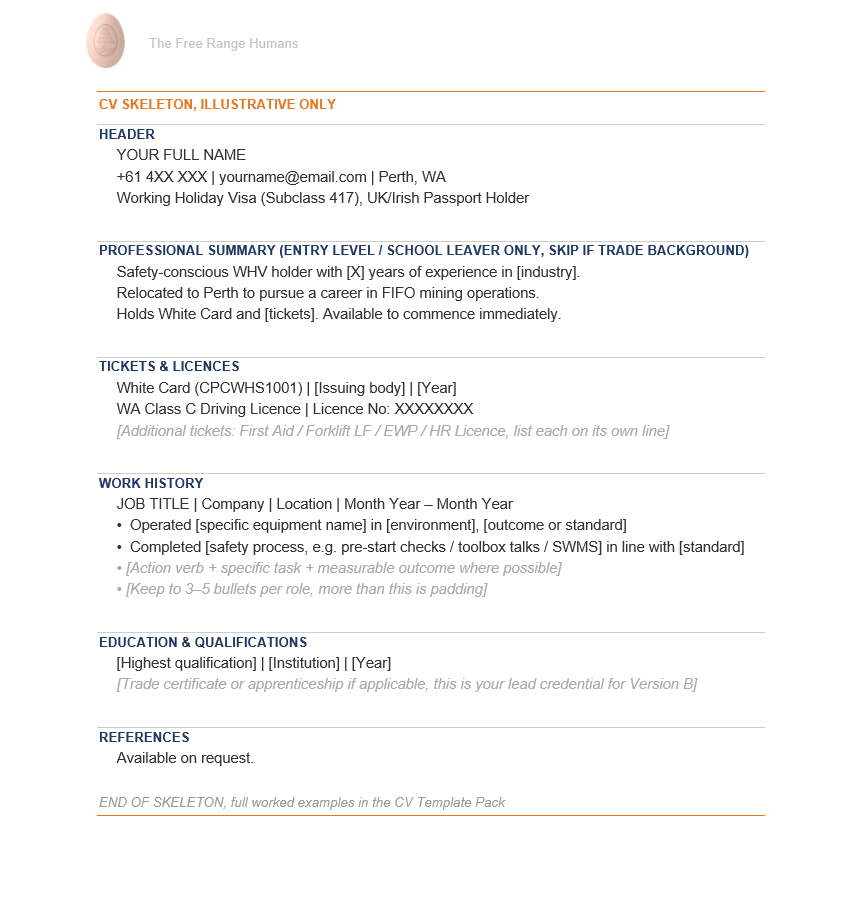
4. The Skeleton, What Each Section Looks Like
Below is a structural skeleton showing what each section looks like. The sample text is illustrative, this is the shape of a strong mining CV, not a finished product. The full template with three completed worked examples (entry level, trade background, and school leaver), the prompts guide, and cover letter pack is in our CV Template Pack.
5. The Language That Gets You Calls
Structure gets you through the ATS. Language gets you the call.
Mining recruiters read dozens of CVs a day. The ones that stand out don't use more words; they use the right ones. And the right words aren't vague.
What doesn't work?
- "Responsible for operating machinery"
- "Assisted with various tasks on site."
- "Good team player with strong communication skills"
- "Seeking a challenging opportunity in a dynamic environment"
What does work?
- "Operated Caterpillar 785C haul trucks in open-cut iron ore environment, completing pre-start checks and maintaining zero at-fault incidents across a 6-month contract."
- "Completed SWMS documentation and toolbox talk signoffs across all active work phases."
- "Maintained 100% attendance across a 3-month contract with zero lost-time incidents."
The pattern: action verb + specific equipment or task + environment or standard. Every bullet point should answer "what did you actually do and where did you do it?" If it doesn't, it's not earning its place.
Equipment names matter enormously. Don't write "operated heavy machinery”, write the machine name, model, and environment. Specificity is the difference between a CV that gets flagged and one that gets passed over.
The exact keywords, phrase structures, and ATS-optimised language for every section, including how to translate UK and Irish safety documentation into Australian mining terms, is in the CV Prompts & Guidance Guide inside the pack.
6. The Most Common Mistakes UK and Irish Applicants Make
These aren't signs of a weak candidate. They're signs of a strong candidate using the wrong template for the wrong context.
Listing a UK or Irish address
Signals you're not in Australia yet. Replace with your Australian mobile and Perth suburb from the moment you land.
Missing or misplaced tickets section
If a recruiter can't find your White Card and licence in the first ten seconds, your CV goes to the bottom of the pile. This section must be near the top, not buried halfway down in a general skills list.
Including a photo
Not standard practice in Australia and actively discouraged in mining. It can also cause ATS formatting issues. Leave it out entirely.
Two-column layout
Looks professional. Breaks ATS systems. Single column only, every time.
Generic equipment descriptions
"Heavy machinery" tells a recruiter nothing. The machine name, model, and environment tell them everything. If you operated it, name it.
CV too long, or too short
Approx. 3 years’ experience: 1 page. Mid to senior: 2 pages max. More than 2 pages signals you haven't edited, which is itself a red flag in an industry that values precision.
Sending a .docx file
Always save as PDF before submitting. Name it YourName-CV.pdf. A .docx file can shift formatting on different systems and signals you didn't read the instructions.
No cover letter
Most applicants don't send one. The ones who do, and do it correctly, immediately stand out. A cover letter confirms your working rights, your Perth availability, and your role target in thirty seconds. It removes the recruiter's doubt before they open your CV.
Our CV Services
If you'd rather not build this from scratch, or you're not confident your CV will pass an ATS filter, we offer four options:
answer a few questions, we write, format, and ATS-optimise your full CV and cover letter from scratch.
| # | SERVICES | PRICE | BEST FOR |
|---|---|---|---|
| 1 | ATS CV CHECKER | £19 | Already have a CV, run it against a real job ad before you apply |
| 2 | CV TEMPLATE PACK, 6 DOCUMENTS | £19 | You want the right format, worked examples, cover letter template, and the prompts guide, all built for the Australian mining market |
| 3 | CV REFORMAT | £99 | You have an existing CV; we strip it back and rebuild it to Australian mining standards |
| 4 | CV DONE FOR YOU | £169 | dave.hill@mail.com |
What's inside the CV Template Pack (£19):
Doc 1, The Blank CV Template, three versions: entry level, trade background, and school leaver/gap year. ATS-optimised, mining-specific, ready to fill in.
Doc 2, The CV Prompts & Guidance Guide, every section explained, the exact ATS keywords, what kills your application, and what to write in each line.
Doc 3, The CV Worked Examples, three fully completed CVs with annotations on every section explaining exactly why it's written that way. No guessing.
Doc 4, The Blank Cover Letter Template, entry level and trade versions, ready to fill in.
Doc 5, The Cover Letter Prompts & Guidance Guide, what mining recruiters want to see, the do's and don'ts, and a pre-send checklist.
Doc 6, The Cover Letter Worked Examples, two fully annotated examples so you know exactly what good looks like.
Bonus, The Safety Question Guide, how to answer the hazard identification question that comes up in almost every mining application and interview, with worked examples from hospitality, trades, retail, and driving backgrounds.
Getting your CV wrong costs you weeks of silence from recruiters. The pack gives you everything you need to get it right, built specifically for UK and Irish applicants applying to the Australian mining market.
Get the CV Template Pack → thefreerangehumans.com/cv-services.
The complete FIFO guide for UK & Irish passport holders
The CV is one piece of the puzzle. The guide covers the full pathway, visa, Perth setup, White Card, agency registration, CV strategy, tax timing, and how to turn a mining season into a genuine financial launchpad.
Zero experience. UK or Irish passport. 90 days to your first paycheck.
Get the guide → thefreerangehumans.com/fifo-guide.
Frequently Asked Questions
Why won't my UK or Irish CV work for Australian mining jobs?
Two main reasons. First, the format, UK and Irish CVs often use two-column layouts and personal statements that ATS software can't read correctly, so your application gets filtered out before a recruiter sees it. Second, the content, Australian mining recruiters expect a tickets and licences section near the top, action-verb-led work history with specific equipment names, and confirmation you're already in Australia. Most UK and Irish CVs don't include any of these.
What is an ATS and why does it matter?
ATS stands for Applicant Tracking System, software that scans, scores, and filters job applications before a recruiter ever sees them. If your CV isn't formatted and written correctly, it gets filtered out automatically. You never hear back, and you have no idea why. Most large mining labour hire agencies in WA use ATS software as standard.
Do I need a different CV for every role I apply for?
Not a completely different CV, but you should mirror the specific language from each job ad in your work history bullets. ATS systems score your CV against the job description, so matching the terminology in the ad increases your score. The structure stays the same. The language gets adjusted per application.
What if I have no mining experience?
Focus on transferable experience, physical environments, machinery, shift work, safety procedures, working in teams under pressure. Hospitality, logistics, construction, farming, military, all translate well when framed correctly. Recruiters at entry level are assessing whether you'll show up and do the work. The CV Worked Examples in our pack include a fully annotated entry-level example and a school leaver example built from non-mining backgrounds.
Should I include a cover letter?
Yes, and most applicants don't bother, which means yours immediately stands out. It needs to confirm your working rights, state you're already in Australia and available immediately, name the role, and give one or two sentences on why you're a fit. Keep it to half a page. Our CV Template Pack includes a full cover letter template, prompts guide, and worked examples.
What format should I save my CV in?
Always PDF. Never .docx. A Word document can shift formatting on different systems and signals you didn't follow instructions. Name your file YourName-CV.pdf. This is one of the details that experienced recruiters notice immediately.
How long should my mining CV be?
Under 3 years relevant experience: 1 page. Mid to senior level: 2 pages maximum. Never more than 2 pages, a long CV signals you haven't made hard editorial decisions, which is a red flag in an industry that values precision. Every line should earn its place.
What's the difference between the CV Template Pack and the done-for-you service?
The CV Template Pack (£19) gives you everything you need to build it yourself, blank templates, prompts guide, worked examples, cover letter pack, and the bonus safety question guide. The CV Done for You service (£169) means we build your CV from scratch based on a short questionnaire. The CV Reformat (£99) sits in between, you send us what you have, and we rebuild it to Australian mining standards.
About the Authors
Vicki & Amy, The Free Range Humans
Vicki and Amy are a couple who spent over a decade working across Western Australian mine sites before going location-independent in 2025. They now travel full time with their daughter. Between them they've covered open cut, underground, processing plant, and operational roles across sites including Greenbushes, South Flank, Leinster, and Port Hedland, as well as physiotherapy, injury management, project management, and business improvement at BHP Iron Ore. The Free Range Humans is where they share everything they know about making it work.
Want to see what this life actually looks like? We share the unfiltered reality of location-independent life with a toddler in tow, the mine site stories, the travel, the chaos, and everything in between.
🎵 TikTok, @The Free Range Humans 📸 Instagram, @the_free_range_humans 👋 Facebook, The Free Range Humans